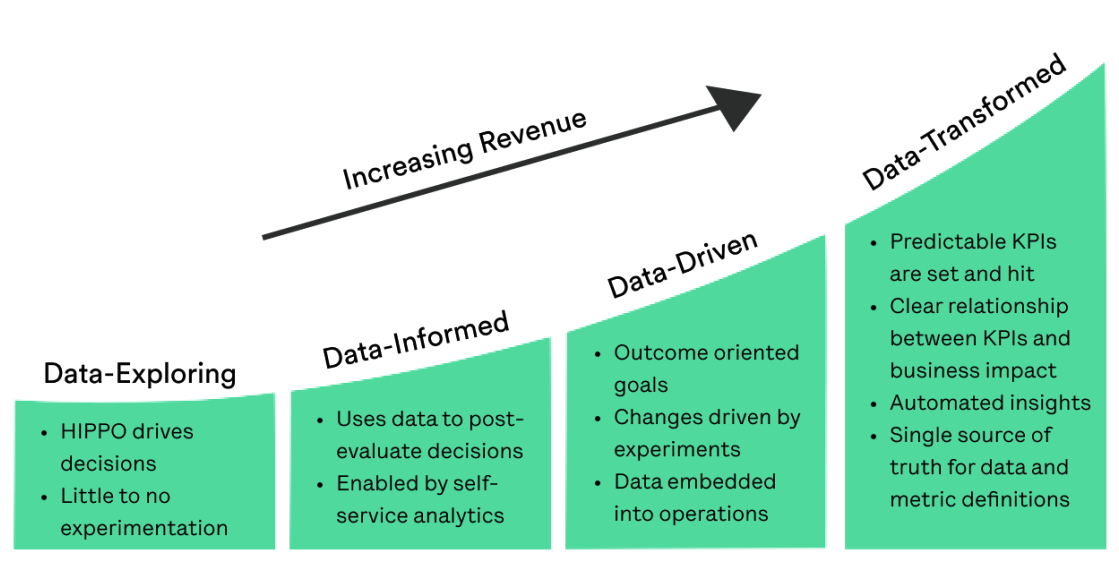
Data maturity is the extent to which a company leverages data to make decisions. Instead of relying on intuition, data-mature companies make decisions based on qualitative and quantitative customer insights that help them achieve 2.5X better business results
Level 1: Data-Discovered
The first level of your data maturity journey is really about discovering the data you have. You need to collect data to drive the right business investments, but you’re not leveraging the full potential of your data. You lack standardized best practices for how and when to use data, as well as data governance policies
Silos across teams and functions blur the lines of how data should be used to drive success. This leads to a fragmented and inconsistent approach to data management Decisions are often made with little or no data, and initiatives are rarely measured for impact, making it impossible to truly learn from each iteration
Level 2: Data-Informed
The second level of your data maturity journey is where we start to see some momentum. You start to see the value of investing in analytics tools, data stacks, and best practices. You’re curious about data-driven tools and want to explore different methods and processes
You start to prioritize investing in data collection and management. You start to establish best practices for roadmap planning and post-launch analytics. You start to analyze success with real-time metrics for each campaign and business plan
Level 3: Data-Driven
You have more democratized access to data and it is embedded in your company culture. Data drives your Go-to-Market and Enhancement Projects strategy and operations. Every initiative is driven by the goal of driving business impact through data-driven decision making by setting business KPIs by optimizing digital experiences
Reliable and comprehensive data is now available to anyone driving planning and execution. You know how to use data to design effective and valuable digital experiments to enhance your digital experiences
Level 4: Data-Transformed
Data is now part of your organization’s DNA. Every team and process is fully data-centric and there is a culture of data sharing across your entire organization.
Everyone across teams and functions is looking at the same metrics and dashboards, and any new hire will quickly learn data-driven principles as they join. You’ve invested in the right areas that drive your business growth levers and committed to delivering on business goals accordingly
Once you’ve established data-driven habits and culture, all you need to do is maintain them by continually investing time and resources into data education, maintenance, and agile optimization
How to Determine Your Organization’s Data Maturity Level?
Determining where you are on your data maturity journey is a critical step in figuring out what to do next. Here are some questions to ask yourself and your team to get started
How do you measure the success of your digital projects?
Are data and analytics easily accessible to your team? How quickly can they find and analyze data to answer questions about product performance?
How does your organization connect product changes to business performance?
How does your organization test new ideas?
Is your team effectively using both qualitative and quantitative data for analysis?
Increasing your data maturity takes time and is critical to improving your business success. You need to change your mindset and put in the work to make it happen. Drive growth by encouraging employees to make data-driven decisions
Remember that these activities will need to evolve over time, so don’t wait another day to start your data transformation journey!